


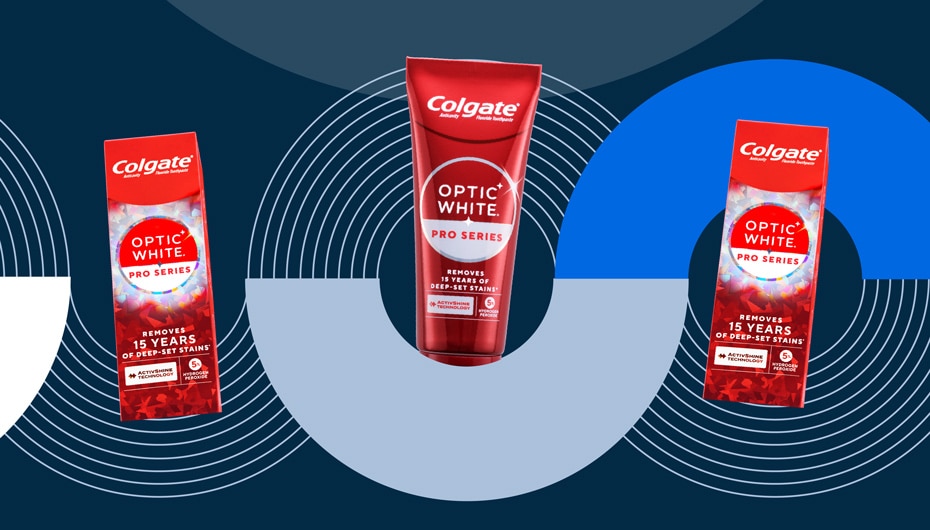
For years, whitening has meant lifting off the coffee, the tea and the buildup that dull a smile. The new Colgate Optic White Pro Series toothpaste still lifts those stains away, but it also does something whitening hasn't done before. Its new ActivShine technology polishes the enamel itself, so the surface reflects more light.
That’s why the formula doesn’t just whiten. Colgate’s Hydrogen Peroxide (HP) Complex helps deliver a visibly brighter smile, while ActivShine helps polish the enamel surface for added shine and a smoother, cleaner feel.
Key takeaways
- Whitening removes stains two ways: micropolishers scrub away stains on the surface, while hydrogen peroxide dissolves deep-set stains inside the tooth.
- Our new ActivShine technology helps polish the enamel surface so it reflects more light, adding shine and a smoother, cleaner feel.
- The 5% HP Complex formula dissolves up to 15 years of deep-set stains and is designed for everyday use without causing tooth sensitivity.
Why isn't a clean tooth always a bright one?
A clean tooth and a bright-looking tooth aren't the same thing. To see why, it helps to know how stains form.
Teeth pick up color from the things we eat and drink every day. Coffee, tea, red wine and certain foods contain compounds called chromogens, which are deeply pigmented molecules that bond to tooth enamel over time. These are known as extrinsic stains, and they sit on or near the tooth's surface.
But some staining goes deeper. Over time, chromogens and other compounds can work their way through the microscopic pores in enamel and settle into the underlying dentin. These intrinsic stains are harder to reach, and are why brushing alone sometimes isn't enough to restore a noticeably brighter smile.
That difference between surface stains and deeper discoloration is why whitening has to work on more than one level. Removing what sits on top of enamel is one part of the job. Reaching the stains that settle below the surface is another.
How does whitening chemistry work?
Hydrogen peroxide is the same whitening ingredient dentists use because of how effectively it targets stains. In a whitening formula, it releases reactive oxygen molecules that break apart the molecular bonds of stain-causing compounds, changing them from pigmented to colorless. This oxidation process works on both the surface of enamel and the deeper dentin layer beneath it.
Hydrogen peroxide became the active standard for at-home whitening in the late 1980s, when dentist-dispensed tray systems first brought the chemistry out of the clinical setting. Early formulas worked, but required long wear times to produce visible results, which made improving both speed and depth of whitening a natural focus for further research.
Colgate-Palmolive has bridged this gap, bringing patented formulas that are engineered to work on both levels, clearing surface stains and penetrating below the enamel to address deeper discoloration within the tooth structure, in a safe way.
How do HP Complex and ActivShine whiten teeth?
Stain removal starts with the complete Optic White Pro Series formula, which is clinically proven to dissolve tough stains below the surface, reaching where a toothbrush can’t. At the center of that formula is Hydrogen Peroxide Complex, or HP Complex — Colgate’s proprietary hydrogen peroxide formulation. With 5% hydrogen peroxide, the formula has the highest level of hydrogen peroxide in the Optic White line, making this the brand’s most advanced whitening toothpaste to date.
Working alongside it, micropolishers — fine particles in the paste — scrub away stains sitting on top of the enamel. Together, those two stain-removal actions are what Colgate calls Dual Whitening Technology.
ActivShine builds on that surface-level whitening work by helping the micropolishers polish enamel more effectively. As the enamel surface is polished, it reflects more light — much like a gloss finish makes paint look richer and more vibrant. Together, the formula’s stain-removal and polishing benefits help teeth look whiter, while adding shine and a smoother, cleaner feel.
How is whitening technology tested before it reaches people?
Before any whitening product makes it to a shelf, it goes through an extensive testing process. It starts with in vitro models — controlled lab environments designed to simulate conditions inside the human mouth — before moving to real-world clinical trials.
Melissa Martinetti, Senior Principal Scientist, Device & Chemistry at Colgate-Palmolive, walks through the process: "We have many different types of in vitro models, because you want to simulate an environment that's close to the human mouth." The team stains those models with coffee, tea and other common dietary culprits, then measures how quickly and effectively the products clear the discoloration.
Lab results are only the beginning. "The ultimate confirmation comes from human clinical trials," Martinetti says, the stage where a whitening claim is finally proven on real people.
The team also draws on a nationwide network of dental professionals who evaluate early concepts and multiple rounds of prototypes throughout development. That feedback, says Ashley-Ann Hernandez Brassard, Senior Research Scientist, Device & Chemistry, is what keeps the work grounded in clinical reality rather than lab assumptions. It makes sure the finished product is something both dentists and the people they treat can trust.
What results can you expect from the Optic White Pro Series?
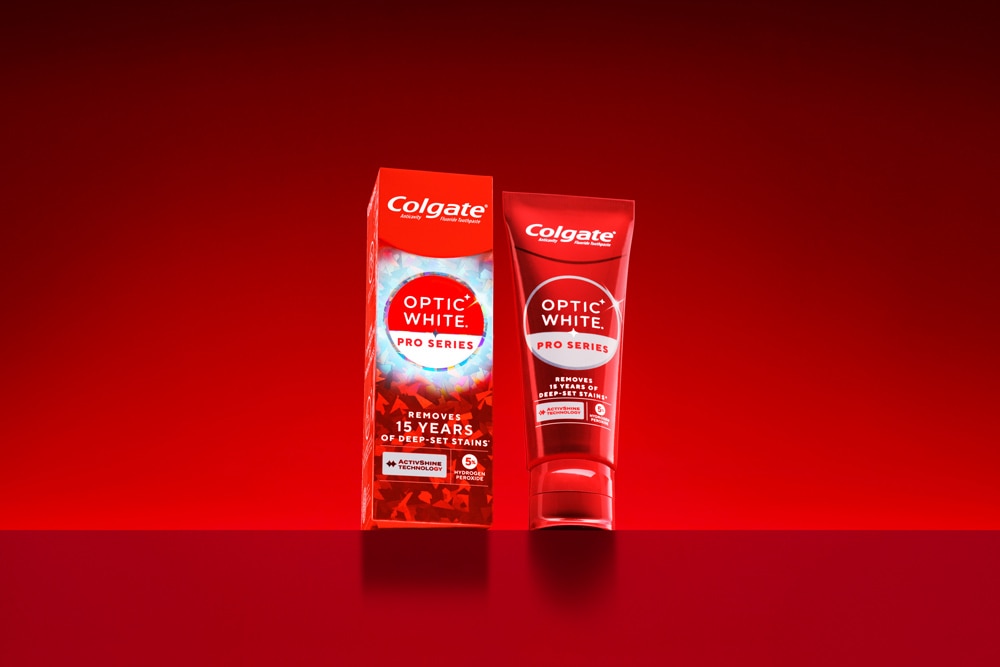
The payoff comes quickly. The formula delivers visibly whiter teeth in three days when used as directed, and dissolves up to 15 years of deep-set stains over two weeks of twice-daily brushing — all while staying gentle on enamel and being designed for no sensitivity.
It comes in four variants, including Express White and Enamel Renewal, across three mint flavors.
How do a whitening toothpaste and toothbrush work together?
The toothpaste does the heavy lifting, but it's only one part of a whitening routine.
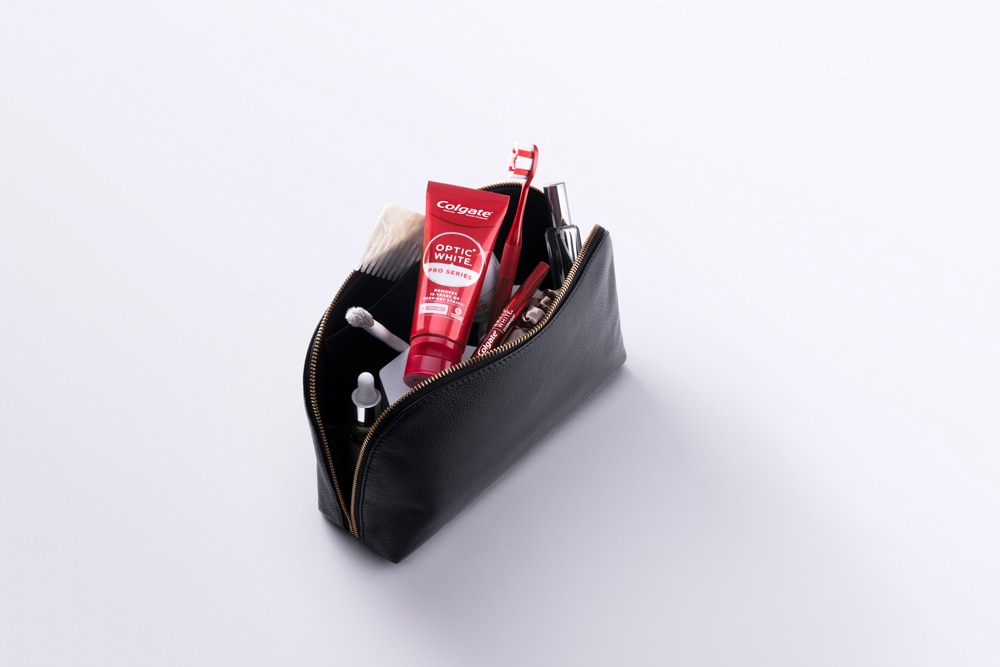
The Colgate Optic White soft manual toothbrush handles stains on the surface. Where most brushes have 900 to 1,500 bristles, this one has over 4,500 soft, multi-height and high-density bristles, reaching between teeth and along the gumline. A polishing star at the center is shaped to lift surface stains as you brush, and the sleek metallic handle is made to sit on the counter like a beauty tool. The brush clears the surface, while HP Complex dissolves what's below it.
Like the Colgate Optic White toothpaste tube, the Colgate Optic White soft manual toothbrush’s packaging is also recyclable. The packaging uses paperboard with a small plastic film window to display the handle color, which doesn’t need to be removed prior to recycling. It can be placed in your household paper recycling (check locally to confirm capabilities).
What began as one question — how do you make a tooth not just cleaner, but brighter? — became a new way to think about whitening. For our team, that's the part worth chasing. "It's very rewarding to develop something that not only helps solve real-world problems, but is also something people genuinely like to use," Hernandez Brassard says.
That's what reimagining a healthier future looks like in practice: science rigorous enough to earn a place in people's daily lives.
The new Colgate Optic White Pro Series toothpaste is available now at major retailers nationwide, in four variants and three mint flavors. The Colgate Optic White Soft Manual Toothbrush is now available at Walmart and at other major retailers nationwide.


